12305 visitors online

Year and half since Marian Penkalskyi’s death: hands tied, head missing. Why is soldier’s wife appealing to Zelenskyy and Drapatyi?

Author: 

The death of Junior Sergeant Marian Penkalskyi of the 503rd Separate Marine Battalion near Dobropillia in December 2024 shocked Ukraine. Everything indicated that the skilled 33-year-old UAV operator had not died of natural causes: his body was missing its head and some internal organs, and his hands were tied behind his back.

While the former could be explained by the fact that the remains were found a month and a half later and the body had been mauled by animals, the latter is more indicative of murder. During the investigation, it emerged that Marian’s vehicle had ended up in the possession of servicemen from the 425th Separate Assault Regiment "Skelia," which was stationed near the site.

Penkalskyi

As of today, it appears that the investigation into Penkalskyi’s death has been obstructed. A year after his death, the military unit filed a report with the State Bureau of Investigation alleging that Penkalskyi had gone absent without leave. The SBI accepted the report, leaving the defender’s wife and three children without social protection or financial compensation. This is despite a court ruling in their favour that invalidated the military unit’s initial documentation alleging that he had gone AWOL.

As for the serviceman’s body, his remains are being held in several oblasts. A burial has taken place, but it subsequently emerged that several more fragments required examination. These fragments have still not been reunited with the other remains or released to the family for burial, meaning Penkalskyi’s relatives may have to endure the painful burial process more than once.

His wife, Iryna Penkalska, recorded an appeal to the President of Ukraine and other state authorities, asking them to facilitate the investigation. So why is a case that once caused widespread shock now shrouded in secrecy, while those who vigorously searched for the serviceman during the first month after his disappearance have now fallen silent? Why was the fallen serviceman’s family not even informed that his remains were being held in different locations? Why is his wife, who is raising three children, being forced to seek the truth and the complete burial of her husband through lawyers?

FACTUAL BACKGROUND: THE WEAPON AND DOCUMENTS WERE LYING NEARBY

Since the pre-trial investigation authorities have released little information publicly, while the military unit declined to comment to Censor.NET; the events of that night can only be reconstructed from the scant testimony available online. On the evening of 18 December, Marian spoke with his wife by phone as usual. He told her that he was due to leave on a mission toward dawn. It was to be his first combat experience using a new type of drone, which he had trained to operate several months earlier. He was anxious. He eventually left for the mission and disappeared afterward. A search was launched, and the command reported him missing. His body was found on the last day of January in a tree line several kilometres from where his unit was stationed. It was in a semi-seated position, without a head, with the hands tied behind the back. His weapon lay at his feet, and his bloodstained documents were also nearby. There is testimony that his cap was found nearby as well, with a bullet hole passing straight through it and an entry hole near the forehead, which may point to the method of execution.

As for the other important details, the questions keep mounting. How far, if at all, was the location where the body was found from the route of Penkalskyi’s combat mission? Did he have a drone and other equipment with him? How did his vehicle end up with servicemen from another unit? Had it been abandoned, or had they taken possession of it themselves? Could he have encountered a Russian sabotage and reconnaissance group, given that drone operators are a priority target for the enemy? If he had a conflict with his "own side," who exactly were these people?

There are currently two criminal proceedings in Marian’s case. One sign of progress is that investigators have all but ruled out the suicide theory, on which they initially insisted. Only recently did the prosecutor’s office reopen the criminal proceedings launched over Penkalskyi’s disappearance and merge them with the proceedings concerning his intentional killing.

In response to a request from Censor.NET, the Main Directorate of the National Police in Donetsk Oblast merely stated that the investigation was ongoing.

The second set of criminal proceedings, concerning possible absence without leave, was opened by the SBI on 1 January 2026, a year after his death.

INVESTIGATION: FROM "SUICIDE" TO MURDER

Tetiana Sadovska, the lawyer representing the victim, the fallen defender’s wife, complains of evidence of falsification and delays in the investigation. However, she notes that they succeeded in drawing attention to problems with the investigation at the level of the Pokrovsk District Police Department. A week ago, it emerged that the criminal proceedings concerning the murder of Marian Penkalskyi had been transferred for investigation to a higher level, the regional investigative department in Donetsk Oblast.

According to her, the new investigator in the case contacted the victim’s representative a week ago and was informed of the main complaints and demands, namely:

- to take all appropriate and possible measures immediately to identify every fragment of the body and resolve the issue of releasing them to the family so they can be buried together;

- to conduct an objective and comprehensive investigation into Marian’s intentional killing, including a detailed examination of all investigative failures.

What investigative failures and complaints does she mean? The lawyer insists that intentional murder is the primary investigative theory. Initially, however, investigators attempted to treat suicide as an equally plausible theory:

"I have an extract from the Unified Register of Pre-Trial Investigations dated May 2025 that contains no mention of suicide because the prosecutor intervened and had the word removed," Sadovska says. "He ordered that this be done immediately. Why? Because investigators had fabricated the factual account of the case. The body was found without a head and without internal organs, while the weapon was lying nearby. Yet they fabricated the account to suggest that he had died by suicide by shooting himself in the head. Just imagine: his hands were behind his back, and his head was missing...

"In addition, I have a letter from the same pre-trial investigation authority stating that intentional murder is the main theory. All the circumstances known to us indicate that this was an intentional killing. It is extremely strange that the vehicle ended up with servicemen from another unit and that the phone ended up with servicemen from another unit. The phone had been wiped and given to someone else.

"I cannot disclose information from the pre-trial investigation. I can confirm that during the court hearing in the administrative case, a representative of the military unit said that the vehicle had been stolen by servicemen from another unit. It is no secret that, in December 2024, servicemen from "Skelia," as well as the Marines, were stationed in the Dobropillia area."

Penkalsky
Penkalskyi

Extract stating that the case is being investigated as "intentional murder"

The police seized these items but did not document the incident as theft.

"Nowhere does it say what happened to the drone and other equipment that had been in the vehicle, or whether they were there at all—neither in the internal investigation nor in the criminal case files. The equipment was supposed to have been entrusted to Marian, but there is not a word about whether it was, whether it was stolen or not. I understand that if the military unit has chosen to accuse Marian of going AWOL, it will deny entrusting him with a drone even if it did so. Had a valuable asset such as a drone gone missing, they would have been required to report it. If they have still not reported it and I assume they have not, they will do everything possible to claim that nothing happened there," the lawyer adds.

A fellow serviceman with the call sign Starych, who had served with Penkalskyi since 2022, knows first-hand that everyone searched for Marian after he disappeared. The military unit’s rhetoric changed after the body was found: "Everyone there lives like one family, so it is very strange that they all closed ranks after Marian’s body was found. Perhaps the command is under pressure. I assume the commander and the other men know more than they are saying.

"It is now clear to everyone that the case was crudely fabricated. I spent a year in hospital, and no one questioned me once. It was only after the case attracted public attention that investigators contacted me to discuss the vehicle (which we had purchased with money raised by volunteers). The fact that it ended up with Skelia servicemen is probably at the heart of the matter. At the very least, it amounted to robbery."

On what grounds did the allegation of going AWOL emerge? Starych is convinced that Marian had no reason to go AWOL. He assumes that, by discrediting Marian’s name, the unit’s command is attempting to deflect pressure that may be connected to what emerged during the investigation.

"We had a good team and went through and endured a great deal together," he says. "We were wounded together on both occasions. Unfortunately, he returned to the military after his second injury. While on leave, he renovated his home because he and his wife were expecting their third child. Marian was then sent to train on a ‘large fixed-wing drone.’ This was essentially a promotion and a sign that he was respected, because it was not a Mavic or a ‘long-range fixed-wing drone.’ I later learned that Marian had a conflict with someone during the training and even called the police on 102. This is a lead for the investigator; we do not know the details.

"We spoke regularly, a couple of times a week. Marian was in his usual excellent spirits. As for the suggestion that he might have gone AWOL, in 2024 we did not even have such a concept yet. It became a phenomenon later. There had been no such cases in our UAV unit, and Marian had no reason to do so."

"His fellow servicemen know that he had served since 2022 and had no reason to flee military service," Sadovska adds. "Moreover, his child had been born, and he had been granted leave. He was looking forward to it; he and his wife were due to have the child baptised. He was also a father of three, so he could have sought legal grounds for discharge from military service.

"In October, Marian underwent retraining in Zhytomyr as a UAV operator. On the night of 18–19 December, he was due to begin his first missions at the new positions. A UAV operator is entrusted with expensive equipment. One of his fellow servicemen said that Marian was anxious because the equipment was expensive. Unfortunately, however, we do not know what happened to it that night. We understand that he was killed on the night of 18–19 December 2024. Whether it was saboteurs or his own side, we cannot know for certain, because establishing that is precisely the task of the pre-trial investigation authorities."

AWOL ALLEGATION: WHY WAS IT FILED A YEAR LATER?

Tetiana Sadovska describes how Marian’s disappearance was documented:

"Marian’s immediate commander, Serhii Vykhovanets, reported his absence to the unit commander. I have seen the text of that report. It states that his absence was discovered at a certain time on 19 December, in a certain location. But was Marian supposed to be in that place? He had actually spent the night in another settlement. Two servicemen who were not among Marian’s close comrades were named as witnesses. His wife knows nothing about them."

This indicates that the initial report submitted to the unit commander did not state that Marian had gone AWOL. It merely confirmed that his absence had been discovered. However, the military unit considers Penkalskyi to have gone AWOL at the time of his death, and his family has consequently been deprived of social benefits.

Serhii Vykhovanets declined to comment on Penkalskyi’s death but had previously said that he had merely followed the established procedure applied when a serviceman goes missing.

"If a commander classifies this as absence without leave, then it is a criminal offence, not a disciplinary matter. Under military regulations and the law, the military unit commander is therefore required to file a report with the pre-trial investigation authority, the SBI," Sadovska explains.

"Accordingly, when I learned that Marian was being accused of this, the first thing we did was submit a request to the SBI. In April 2025, I received a response stating that no criminal proceedings concerning Marian existed. I contacted the military unit again and asked whether it had reported the alleged absence without leave to the pre-trial investigation authority. The unit replied that it had not."

Penkalskyi

"In other words, they discovered his absence and drew up an internal investigation report stating that he was absent and that this therefore amounted to going AWOL. They deprived him of his military pay and deprived his children of the financial support to which they were entitled as the children of a serviceman who went missing while performing his military duties—all based solely on the assumption that he had fled. But in such cases, the law requires them to obtain an extract from the Unified Register of Pre-Trial Investigations. Only with the relevant extract can a military unit claim that a serviceman has gone AWOL."

Penkalskyi

The military unit’s response stating that it had not contacted the SBI

After receiving the military unit’s response stating that it had not contacted the pre-trial investigation authority, the victim’s lawyers applied to the court to have the military unit’s documents declaring that Marian had gone AWOL annulled as unlawful. Annulment of these orders falls within the court’s jurisdiction because the higher command had failed to do so. The court upheld the claims brought by Marian’s family, annulled the military unit’s orders and instructed it to conduct a new internal investigation taking all known circumstances into account.

The lawyer says that the court ruling established several important facts:

"For example, Marian Penkalskyi’s immediate commander, Serhii Vykhovanets, who reported that Marian had disappeared and that his personal belongings were missing, personally sent those same belongings to his wife via Nova Poshta on 17 January 2025.

"He did so personally, rather than through the Territorial Centre of Recruitment and Social Support with an inventory, as required. It follows that he reported that Marian’s personal belongings were missing when, in fact, they existed. Why did he do that? The first internal investigation was being concluded on 17 January, and they were required to list those belongings. Where did they find them? What was among them? Was the phone there? Were there other items? They did not do this."

It was also during the administrative court proceedings that the lawyers and the victim learned that the DNA examination report was already complete, even though the lawyer had submitted appeals and requests to the prosecutor’s office and the pre-trial investigation authority regarding the DNA examination in both June and July.

Penkalskyi

Penkalskyi

Penkalskyi

Penkalskyi

Penkalskyi

Document concerning the shipment of the belongings via Nova Poshta

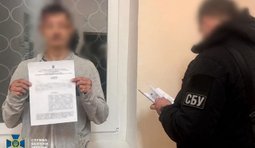
Following the court proceedings, the military unit finally did what it should have done from the outset: it contacted the SBI to request that criminal proceedings be opened over the alleged absence without leave.

In response to Censor.NET’s request asking the State Bureau of Investigation on what grounds it had opened proceedings against a serviceman who had died more than a year earlier, the Bureau said that the proceedings had been "initiated following a report from Military Unit A1275 dated 20 December 2025." At the same time, the Bureau assured us that "the circumstances of the criminal proceedings would be examined comprehensively, fully and impartially."

Sadovska can only speculate as to why the military unit ultimately contacted the SBI, but she is certain that she understands why it did not do so back in December 2024:

"A year later, despite knowing that Marian’s body had been found and that the identification of his remains was a complicated matter, they contacted the SBI, obtained an extract from the Unified Register of Pre-Trial Investigations and submitted it to the court. Had they acted in accordance with the law and contacted the SBI on 19 December 2024, the SBI would have conducted a proper pre-trial investigation and requested all the records, including the logs. I assume that the logs were rewritten because, during the court hearing, a military unit representative said that Marian had been given a combat order and was due to begin carrying it out on the night of 18–19 December. He confirmed this verbally several times but added that it had not been recorded in the log because the logs are completed retroactively. The judge was shocked by what she heard, and the expression on her face could not conceal it.

"So now we have won an administrative court case in which the unlawful orders issued by the military unit, through which Marian was declared guilty, without a trial or investigation, of something he did not do, were annulled. But we also have a new extract from the Unified Register of Pre-Trial Investigations and new criminal proceedings in which our ability to fight is limited because we are not parties to those proceedings. We cannot obtain victim status, review the case files, or request investigative actions."

REUNITING THE BODY: A LONG MISSION

Tetiana Sadovska has been handling cases involving the families of missing persons since 2022, so she understands how important it is for all fragments of a body to be recovered and buried together. She recalls the fate of servicemen killed in an air strike in Kyiv Oblast in 2022. She spent a year and a half collecting fragments of their remains from different morgues. Some families had to hold three or four, or even five, burials, forcing them to relive their loss and grief time and again. To prevent a similar catastrophe and spare the Penkalskyi family such suffering, she has made the burial of the remaining fragments a separate issue in her communications with law enforcement authorities. For now, however, it appears that they are insensitive to the family’s plight.

"We learned that the Eastern Region Specialised Defence Prosecutor’s Office had provided journalists with false information, alleging that the family had not asked prosecutors to release fragments of Marian’s body for burial and that only the left and right shoulder blades remained in storage.

"We therefore state officially that this is untrue. As soon as the family learned that a DNA examination report concerning the body had been completed, they immediately contacted the prosecutors, demanding that they establish the location of all the fragments and resolve the issue of authorising their burial.

"Since February 2026, motions, complaints and requests concerning this matter have been submitted every month, yet no one has provided a substantive response. We have evidence of this and have also submitted a complaint to the Eastern Region Specialised Prosecutor’s Office. It is deeply distressing that, over the course of six months, the responsible prosecutors and investigators have failed to examine the case files closely enough to learn that, in addition to the shoulder blades, fragments of the skull and jaws also remain.

"We hope that the negligence that has now come to light will not result in further retaliation against the fallen serviceman’s family through continued attempts to discredit him as a member of the Armed Forces of Ukraine who remained faithful to his oath of allegiance to Ukraine. Instead, we hope it will help restore his honour through an objective and comprehensive pre-trial investigation conducted within a reasonable timeframe."

As for the examination of the body, the lawyers have questions not only about the dispersal of the fragments but also about the quality of the initial forensic examination, which has made it impossible to establish many important details. The initial examination, conducted in Dobropillia, was intended to establish the cause of death, and all bodily injuries should have been documented. The body should also have been examined and photographed.

"Instead, the body was not examined, and no photographs were taken. I filed a complaint over this because it constitutes gross negligence in the investigation of an intentional killing. Even if they had wanted to attribute the death to suicide, the condition of the skin and any bruising should have been photographed and included in photographic records, which become evidence as the documented results of investigative actions.

"We succeeded in securing a second, comprehensive forensic examination in Lviv. When the body was brought to Lviv, the military unit was in a hurry to proceed with the burial, but his wife contacted me as a lawyer. My task was supposed to be very simple: to secure a second examination.

"I was not directly involved in organising the funeral. Representatives of the military unit handled that. I know that representatives of the morgue and the military unit told the family that the body was decomposing rapidly and had to be collected urgently.

"There was a significant difference between the condition of the body when it was brought to Lviv and its condition by the time the examination was conducted. Irreversible putrefactive changes had occurred, making it impossible even to assess the condition of the skin or determine whether there might, for example, have been marks from handcuffs on the wrists or other significant traces."

Sadovska suggests that, on the one hand, the process was deliberately delayed while, on the other, the burial was expedited so that evidence that could have helped identify the true perpetrator, or at least clear Marian of the AWOL allegation, would be lost.

"After the funeral, I asked the forensic expert whether they had released everything. It was then that he told me that they had released the torso but retained parts of the skull for further examination. That is how we learned about it. When I had access to the case files, I saw that, in addition to the torso itself, fragments of the skull and jaws had been found at the scene. We therefore began trying to establish where they were and insisted that they be transferred to Lviv for a second examination together with the body. When I attended the second examination here in Lviv, I saw all those fragments. In other words, I know that they are both documented in the case files and physically present," she added.

The DNA identification examination, which was supposed to confirm that all the fragments belonged to Marian Penkalskyi, has also raised concerns. Such an examination is conducted by experts taking a sample from a fragment of tissue or bone and sending it to a forensic centre for analysis. The victim’s representatives secured the collection of DNA samples from all the body fragments to prove that they all belonged to Marian.

"So what did they do? They took samples twice from the torso itself but, as it turned out, took none from the fragments of the skull or jaws. These fragments, the collarbones, jaws, and skull fragments, are now located in different oblasts. Some remained in Lviv because they were not released for burial, while others are being stored in Donetsk Oblast.

"In February, we learned that the initial DNA examination had been completed, but no one informed the victim. For several months, the investigator failed to send the samples collected for DNA testing to the forensic centre. In other words, the DNA examination had already been delayed. We filed complaints in May and reviewed the case files in July. As I understand it, he did not send the samples for DNA testing until June. The body was found in February, and the man was killed in December, yet it was not until June that he finally managed to send the samples for DNA testing.

"We demand that these fragments be reunited, identified without delay and released to the family. I have no doubt that the fragments being held in Lviv will be released to us. We also demand that the pre-trial investigation authority responsible for all these delays issue the family with an official identification decision. Either the prosecutor or the investigator can do this."

Iryna Penkalska, the fallen serviceman’s wife, only recently found the strength to comment publicly on the investigation into her husband’s death. She says that she has seen some progress in the case following the public outcry, and is therefore now appealing not only to the President but also to the country’s highest military command:

"It is difficult for me to talk about this because I know the condition in which the body was found. Since February, we have been fighting to have DNA samples taken from all the body fragments and to have all the remains released to us for burial.

"All I can do now is appeal to the new Commander-in-Chief, Mykhailo Drapatyi, to take this matter under his personal supervision. There must be an investigation, and Marian’s name must be cleared. How can anyone speak of absence without leave when people who go AWOL stay at home, rather than having their bodies found in military uniform in Pokrovsk district?"

She adds that the case has reached such a level of absurdity that it is no longer merely about establishing the truth concerning her husband, but also about ensuring dignified treatment of servicemen, because anyone could have found themselves in Marian Penkalskyi’s place.

 Olha Skorokhod, Censor.NET