



Patriot games: who is stirring up cold "mini-war" between Poland and Ukraine, and what must be done to stop Putin from applauding
If there is one word that can describe Ukrainian-Polish relations here and now, it is "a shame". Moreover, in both of its primary senses.
This is what it looks like: politicians on both sides (but mostly on the Polish side) are damaging relations between the two countries deliberately, for the sake of ratings, inflaming their electorate with pain and bitter grievances from past centuries. In just a few months, much of the good and worthy work that both countries had built over the previous decades has been destroyed. And it is deeply regrettable to see this shared achievement of several generations of Ukrainians and Poles being squandered.
FROM THE SINCERITY OF 2022 TO "EASTERN LESSER POLAND-2026": PUBLIC DISCOURSE IN POLAND HAS BEEN SEIZED BY THE RIGHT AND THE FAR RIGHT
Every day, the chronicle of damage is replenished with new words and actions. The initiative here lies with the Polish right and far right. The undisputed leader is Karol Nawrocki. The Polish president criticizes the law on the national pantheon of the Ukrainian people adopted by the Verkhovna Rada and says that Kyiv, in its historical policy, more often "crosses the boundaries of good-neighborly relations."
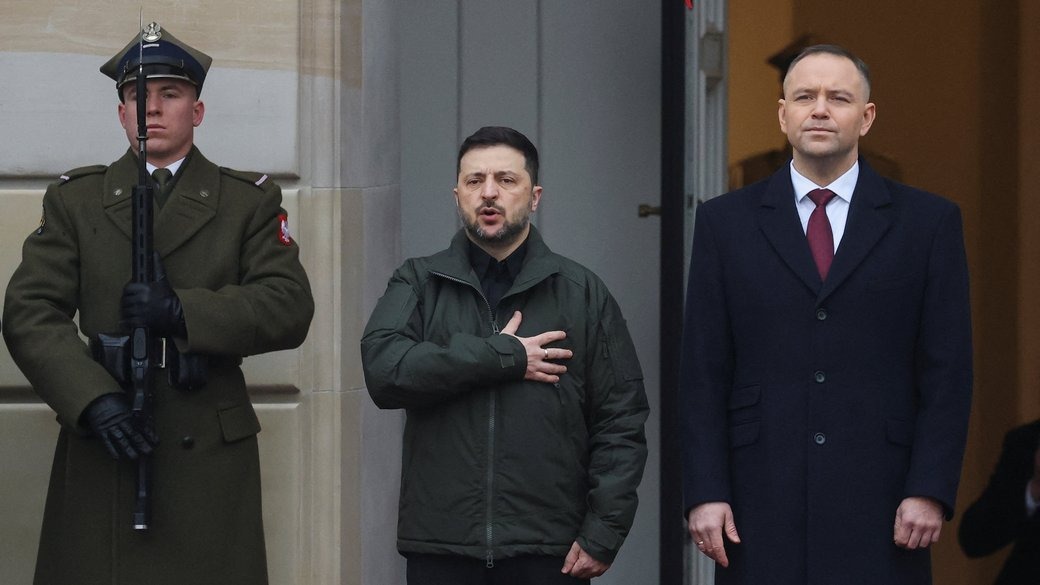
December 2025: Karol Nawrocki receives his Ukrainian counterpart at the Presidential Palace in Warsaw. Even then, a chill could be felt in relations; the pain points remained unchanged: the Volyn tragedy, refugees, and customs control over Ukrainian agricultural products. Nevertheless, Nawrocki said that Zelenskyy’s visit "was good news for Warsaw and Kyiv, and bad news for Moscow."
His office concludes that Nawrocki "was right" when he criticized the Ukrainian authorities and declared his intention to revoke Volodymyr Zelenskyy’s Order of the White Eagle. And the head of this office, Zbigniew Bogucki, refers to the regions in western Ukraine as "Eastern Lesser Poland." Even if used in a historical context, this is already a foul, and a blatant one: public, mocking discourse in the spirit of the Nazi leadership of the second half of the 1930s. It is hard to imagine Kyrylo Budanov or Andriy Yermak allowing themselves similar verbal escapades toward their Polish neighbors. And this is one of those cases where the often controversial practice of adding people to Myrotvorets’ "blacklist" was expanded with a new case that was not exactly controversial.
The information pressure on Ukraine from the Polish president and his allies does not let up for a single hour. At times, it seems as though Viktor Orban, on his way out of office, bit Karol Nawrocki and his acolytes. The same obsession with Ukraine and its "sinister plans"; the same flavor of Russian propaganda in the wording of statements, plus Zbigniew Bogucki in the role of Peter Szijjarto. And the same link to elections (parliamentary ones, next year). With one caveat: unlike Orban’s inglorious finale, Nawrocki’s approval rating is steadily rising, all the way to a historic record, as his social media enthusiastically reports. And that, of course, will encourage him to keep playing these "patriot games."
Polish politicians are being forced to react to this artificially cultivated surge of indignation among the Polish people — and now even the traditionally restrained Prime Minister Donald Tusk is warning that Warsaw is ending its policy of unilateral concessions and "benevolent treatment" amid the current tensions in bilateral relations with Ukraine.
Listing all the angry quotes from right-wing Polish politicians here would mean wasting the respected reader’s time. But everyone listened to this comment by Law and Justice party leader Jaroslaw Kaczynski. Because it formulated the main point:
"Ukraine cannot be admitted to the European Union if it does not completely reject the course it has chosen today… Poland, in its own interests, but also in the interests of European countries, and moreover, in the interests of all Christian civilization, cannot allow Banderism — one of the most criminal and inhuman ideologies, which today shapes the consciousness of the Ukrainian nation — to be admitted into this community."

It is hard to say what there is more of in this statement: the speaker’s internal understanding that neither Ukraine nor its leadership will hit the brakes in their collective assessments of the historical past and in their plans to build a national pantheon (and that, therefore, it will be possible to justify to the Polish people and the EU a refusal to admit Ukraine to the EU); or the hope of repeating the inspiring example of Peter Magyar, who, after coming to power, quickly secured concessions from the Ukrainian side regarding the Hungarian minority in exchange for Hungary giving a green light to Ukraine’s European integration plans...
Of course, not all Polish politicians are shouting about "Banderism" that "today shapes the consciousness of the Ukrainian nation." We have also heard calls not to give in to anti-Ukrainian hysteria from Speaker of the Polish Sejm Wlodzimierz Czarzasty, the author of the "Polish economic miracle" Leszek Balcerowicz, and former Polish President Aleksander Kwasniewski, along with other reasonable politicians.
But for now, public discourse in Poland has been seized by right-wing and far-right politicians. And Ukraine is present in the information space as never before: coverage of our "hot" war with Russia has now been joined by Warsaw’s cold information "mini-war" with Kyiv.
- "What did the Polish journalists who asked you for comment want to know?" I ask a member of parliament from the pro-government faction. The previous day, he voted for the law "On the Ukrainian National Pantheon."
- "It’s obvious what," the MP replies. "‘Will Stepan Bandera be in your pantheon?’"
Polish media are carefully poring over analytical pieces by their Ukrainian colleagues and pulling apart Volodymyr Zelenskyy’s statements for quotes. Publicists are writing columns that differ in tone and arguments (after all, Poland has a long tradition of a free press): for instance, in Polityka, Adam Szostkiewicz, among other things, reproaches both presidents, saying that both Nawrocki and Zelenskyy are using the ideological component of the conflict to boost their ratings and, ultimately, win elections. Both have forgotten, the author says, those recent times when the leaders of both countries pragmatically adhered to the view that the future should be the priority.
And in the measured Gazeta Wyborcza, in an article titled "Letter to a Ukrainian friend," Jaroslaw Kurski stresses that politicians are cynically playing the "anti-Ukrainian card" for future elections, which benefits only the Kremlin. In his view, the way some Polish politicians are behaving does not reflect the real attitudes of many Poles.
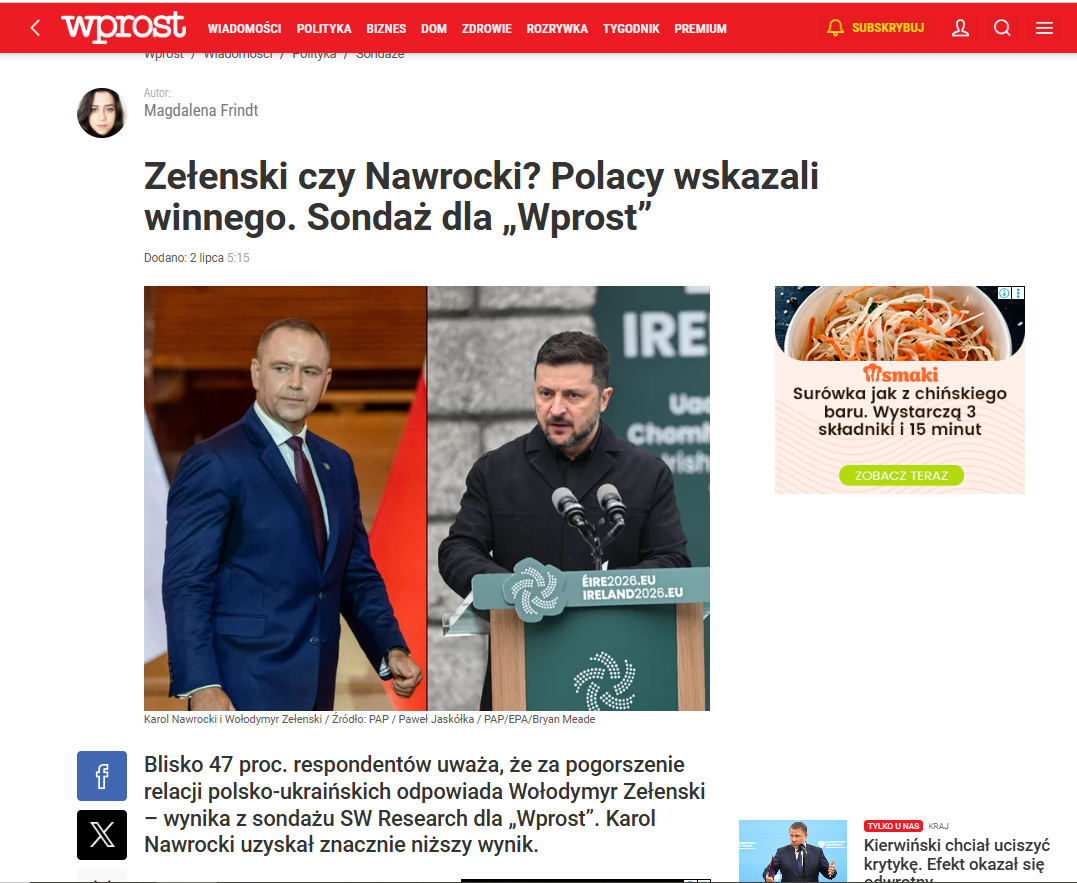
Such assessments are encouraging, but then you open, for example, Wprost — and learn that, according to a poll commissioned by the outlet, about 47% of respondents believe Volodymyr Zelenskyy is to blame for the deterioration of Polish-Ukrainian relations. Only 16.4% assign that unpleasant role to Karol Nawrocki.
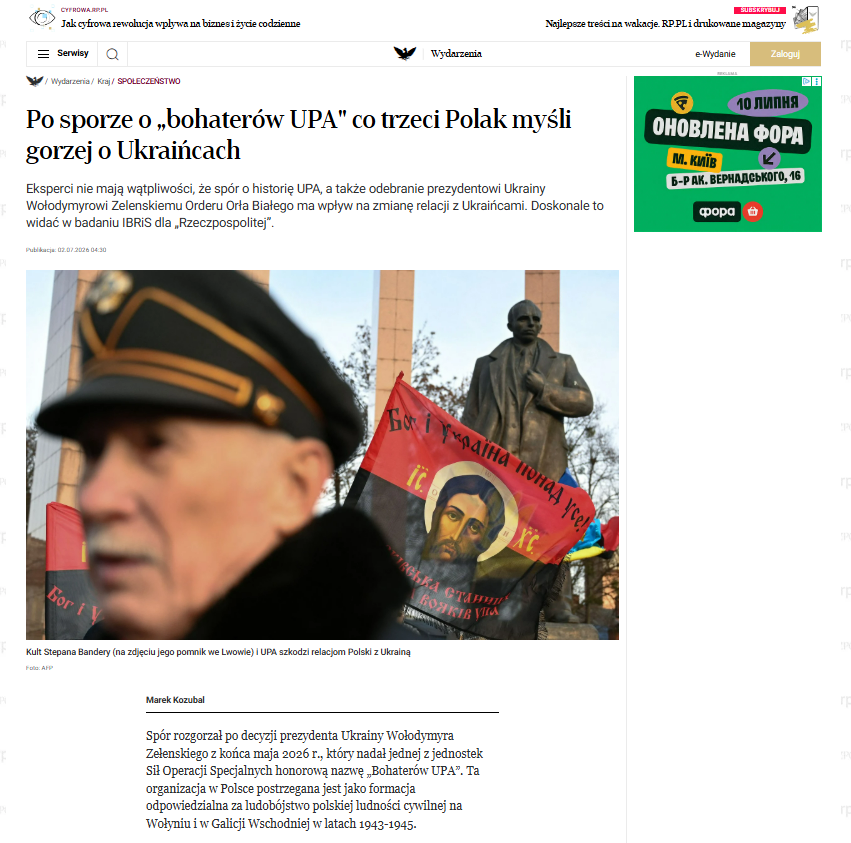
And in another poll, commissioned by Rzeczpospolita, Poles were asked whether their attitude toward Ukrainians had changed in connection with the dispute over the historical role of the UPA (Ukrainian Insurgent Army) and the stripping of President Volodymyr Zelenskyy of the Order of the White Eagle. "Yes, it has changed for the worse," 33.6% of respondents answered; "Yes, it has changed for the better," 1.8%. "No, it has not changed," 60.7%. Another 3.8% did not know how to answer.
"WHAT SHOULD WE DO NOW WITH THIS SHARPENING OF RELATIONS? WE NEED TO WORK WITH POLISH POLITICIANS AS MUCH AS POSSIBLE"
To understand where these percentages in the polls came from and what processes in the shared life of Poles and Ukrainians they reflect, we spoke with Marharyta Sytnyk, a journalist and co-founder of the NGO Holka. Marharyta lived and worked in Poland for seven years, and after the start of the full-scale invasion, returned to Ukraine. She knows and loves Poland, has maintained many contacts there, and recently visited Gdansk for the Ukraine Recovery Conference.

"The fact that relations between us have now sharpened on historical grounds," Sytnyk says, "is, unfortunately, no accident. The historical issue became a particularly important part of Polish political discourse probably back in the 2010s, when the Polish economy began to grow, and Poland began to rethink its own agency.
It should be noted that the historical trauma of the Volyn tragedy is still alive in Polish families. I have several Polish acquaintances who remember stories about the Volyn events passed down by their grandmothers. For example, I am friendly with a family that was saved by a Ukrainian family during the events in Volyn and then fled to Poland. I also know people whose family members were killed during the Volyn tragedy — and yet they have a positive attitude toward Ukrainians and do not hold a grudge.
At some point, the conservative government defined historical policy as one of its key areas. And an electoral game began around this issue. I remember the Law and Justice party coming to power in 2015 — that was exactly when I arrived in Poland to work as a journalist. Literally the following year, in 2016, the Sejm adopted a resolution recognizing the events of July 11 in Volyn as genocide against the Polish people, committed by Ukrainian nationalists in 1943-1945. In Ukraine, this is called a tragedy; in Poland, it is called genocide. And even then, unfortunately, Polish politicians began earning electoral points on this historical issue — although at the time it did not find such broad support in society, while Ukrainians did not understand why it was so important to Poles.
After the full-scale invasion, a very large number of Ukrainian refugees — more than a million — came to Poland, and Poland became the second country in Europe after Germany in terms of the number of refugees it accepted. During the first two years of the full-scale invasion, there was, let us say, a socio-political taboo on criticizing Ukraine and Ukrainians, and on playing historical and political games around risky topics. Although right-wing forces did try to fan the flames. For example, since July 2022, the Confederation of the Polish Crown — the most far-right party, led by the staunch Ukrainophobe Grzegorz Braun — has been implementing the "Stop the Ukrainization of Poland" project and holding several demonstrations in Polish cities. But at the time, they were small. For instance, in September 2022, about 200 people came to an anti-Ukrainian march in Warsaw with slogans such as "This is Poland, not Ukrpol" and "Mr. President, have you already received the Order of Bandera?" — referring to Andrzej Duda and his support for Ukraine and, in particular, Ukrainian refugees in Poland. And in the small town of Sanok, no one came at all.
That is, the Volyn issue was in the background all along. Then came the grain crisis, while Russian propaganda, in tune with Polish far-right politicians, was pushing narratives that Ukrainian refugees were supposedly living on social benefits, driving expensive cars, taking away all social goods from Poles, and even taking husbands away from Polish women.
Later, on July 11, 2023, on the 80th anniversary of the tragedy, the Polish Sejm adopted a resolution commemorating the victims of the Volyn tragedy, stating that Polish-Ukrainian reconciliation must include "acknowledgment of guilt and commemoration of the victims."
And from 2024 onward, this topic began to be actively whipped up in public discourse — both by Kremlin propaganda and by Polish far-right politicians. Their narratives often overlap. The activities of the Confederation Liberty and Independence party, and later the Confederation of the Polish Crown, became more visible. On their social media, Grzegorz Braun and his supporters promote the so-called "Ukrpolin" conspiracy theory. Polin is the Jewish name for Poland. The claim is that Ukraine, allegedly in collusion with either Germany or Israel, is trying to seize Poland. And Zelenskyy, in fact, fits this framework very well because he supposedly has a Jewish passport.
And in this context, they are spinning up the issue of the Ukrainization of Poland. The claim is that Ukrainians in Poland are already seizing power. There was, for example, such a story: a local politician, Anna Tymoshenko, was running for the council in Czestochowa. Posters with her photo and her first and last name, "Anna Tymoshenko," on a yellow-and-blue background were put up around the city. This fake was actively spread on social media. People wrote on Twitter: "Look, Ukrainians are already seizing power in Poland!"
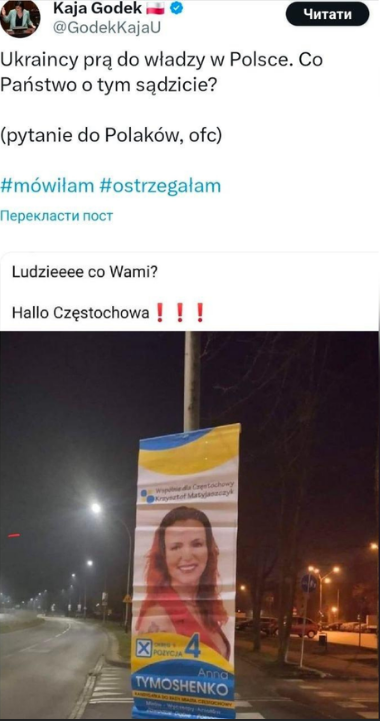
Although, as it turned out, Anna Tymoshenko is Polish, and she took the surname of her Ukrainian husband, Tymoshenko. And the yellow-and-blue flags are the colors of the flag of Czestochowa...
If you now read social media and watch speeches by some politicians in communities and towns across Poland, they talk about the need to deport Ukrainians, especially those of mobilization age. This thesis is now being actively promoted by politician Janusz Kowalski; he was an MP from Law and Justice, but is now unaffiliated. If you visit his Facebook page and listen to his speeches in the Sejm, it seems that there is no other domestic political agenda in Poland except the Ukrainian issue.
Only occasionally do some posts and speeches about drinking water or other domestic issues that affect the lives of Poles slip through. But the political discourse is focused precisely on Ukrainian issues. Yesterday, Ukrainians had to be deported; today, one has to consider whether the airport in Rzeszów (which is a military and political hub for Ukraine) should be closed for repairs. And everything is in the same vein.
Is "Poles’ fatigue with Ukrainian refugees" really one of the reasons behind the activation of anti-Ukrainian sentiment?
Indeed, after the full-scale invasion, such a large number of Ukrainians appeared in Poland that this also triggers Poles, because the war has lasted longer than we all expected. After the Second World War, Poland became a monoethnic state. And although many Ukrainian labor migrants had been coming to Poland before 2022, they were not as visible in Polish society.
Now, despite the fact that Ukrainians are not simply working — they are showing an unprecedented employment rate of nearly 80 percent. According to a Deloitte study, Ukrainian refugees accounted for 2.7 percent of Poland’s GDP in 2024. Thanks to labor migration from Ukraine, Poland is now among the world’s top twenty economies. But all these facts are ignored, while the message most often heard in public discourse is about supposedly supporting ungrateful Ukrainians.
Such fakes are spread both by Polish politicians and by Russian propaganda. The latter is working very actively in this field — and with a very good understanding of the Polish context. For example, claims are spread that Ukrainian women are "stealing" Polish men. A great many videos and photos are created using artificial intelligence. These deepfakes are often directed against Ukrainian activists in Poland. In fact, all key Ukrainian organizations in Poland and individuals — such as Ukrainian House and Myroslava Keryk, or Euromaidan-Warsaw and Natalia Panchenko — have already been targeted by disinformation campaigns. Fake pages of their organizations have appeared on social media, posting anti-Polish statements. There were also statements along the lines of, supposedly, we do not recognize the Volyn crimes of the UPA, and so on. And all of this was amplified on social media.
Unfortunately, as studies show, this "whipping up" on social media has its effect. It has the greatest impact on pensioners who sit on Facebook in villages and small towns. And most of the hateful comments (apart from, of course, bots driven onto social media) actually come from such older people, who believe these fakes and start commenting.
In addition, during last year’s presidential campaign, the Ukrainian issue unfortunately became one of the mainstream topics in the domestic political struggle. The key political forces tried to gain electoral points by criticizing Ukraine and Ukrainians. This inflaming of anti-Ukrainian sentiment is moving from the internet into offline life. The Ukrainian community in Poland is increasingly feeling attacks because of its activities. This primarily concerns the largest Ukrainian organizations, whose work is visible.
There have been several cases of beatings on public transport, including of a human rights defender who decided to stand up for a Ukrainian woman. Such situations most often happen specifically on public transport. Because it is used en masse by people who earn less money. These are the people who are the first to "buy into" various anti-Ukrainian narratives. When they hear the Ukrainian language, it triggers them. And this is more typical of small towns, where the chances of encountering Ukrainians are higher, and there are fewer educated people than in large cities.
Ukrainian children are also being bullied in schools. A high-profile case took place in Slupsk this year, where a teacher called students from Ukraine "scum" and incited other children against them, after which Ukrainians were beaten, and attempts were made to make them the guilty party. Recently, in Warsaw, a Ukrainian teenager was beaten by an adult Pole. And in general, I hear sad stories from many Ukrainian acquaintances about having to transfer a child to another school. Even from a private one, because the child is made almost responsible for the Volyn tragedy. Because at school, they begin to teach history about the Volyn events, among other things. And Poland has its own historical canon, according to which "Ukrainian nationalists kill Poles." Besides, children hear what their parents say at home, and then come to school, meet a Ukrainian classmate — and then it starts.
These stories are not widespread, but there are already enough of them to sound the alarm. That is why this year Poland created specialized prosecutor’s office units to combat hate crimes and aggression.
As a result, Ukrainians have begun to proactively restrict themselves in certain expressions of their Ukrainian identity. Some have stopped speaking Ukrainian on public transport. One acquaintance of mine, the head of a civic organization, holds a prayer for Ukraine in a small town in Poland. She says that many Ukrainians and Poles usually came. But the last time she did it, only 15 Ukrainians and 50 Poles came. It turned out that Ukrainians are simply afraid to attend because they think they may be beaten or face other negative consequences. After that, the next event — for Ivana Kupala — was canceled.
Do I see some share of blame on the part of Ukrainian politicians in what is happening?
First: Poles were deeply offended by Zelenskyy’s speech at the UN in 2023, when Andrzej Duda was president. The grain crisis was already in full swing then, and Zelenskyy said that "some of our friends in Europe… are helping set the stage for a Moscow actor." Although Duda himself at the time compared Ukraine to a drowning person who could drag their rescuer down into the depths.
Poles also remember the situation with the missile in Przewodów, when disputes raged in the public sphere over whose missile it was: a Russian one or fragments of Ukrainian air defense. There were many emotional statements on both sides, which were picked up by politicians and inflamed by Kremlin bots and propagandists.
This set off a trigger that has brought us to the point where we are now probably at the worst stage of Polish-Ukrainian relations in perhaps all the years of Ukrainian independence.
Of course, there are also positive developments. We all remember that there were forums of Ukrainian and Polish historians. Well, this forum has now resumed its work. Exhumations are already underway in Volyn, and Poles have access to them.
But such positive steps in the information space do not outweigh the negativity that had been accumulating, exploded, and is constantly being heated up by politicians and propaganda.
What should we do now with this sharpening of relations?
We probably still need to take into account that Poland remains our strategic partner and an important military hub, while, with Ukraine’s accession to the EU, Poland feels future competition in the economic sphere. But on the other hand, yes, this is a very fine line — taking into account our own interests and the heroization of our own historical figures, which is very important for Ukraine, given the context in which we live; the fact that we are fighting for our existence and genuinely want to honor those people who were engaged in this for centuries.
It seems to me that we need to work with Polish politicians as much as possible. And to look for allies among skeptical politicians, but those who are capable of listening.
In June, I attended the Ukraine Recovery Conference in Gdansk and spoke with several representatives of institutions, including government institutions, about what we can do to either defuse the situation or at least prevent it from escalating. Some of them said that "although we are state institutions, we understand the shared challenges and the danger of worsening relations." They suggest that think tanks — Polish and Ukrainian ones — should meet to find this common solution. But from each of them, one could hear the same thing: if only no new information triggers appeared! Ones that Poland, first and foremost, could seize on and spin into a new information wave... We can see that the FSB has now become active in this direction, fabricating evidence of the UPA’s involvement in the Volyn tragedy.
It is also worth talking about the shared positive things that exist between our countries. Here, the media and the civic sector should get involved. And we have a lot of good things in common — in cuisine, traditions, and music.
And in history, too: Poles and Cossacks once stormed Moscow together, and now the Armed Forces of Ukraine are setting it on fire. Even if we take that same Volyn history, the Home Army and the UPA did in fact hold negotiations — and at one point were allies. In May 1946, the UPA and the Home Army, joining forces, routed an NKVD unit in Hrubieszów. We need to remember that we have a common enemy, but also learn to live in peace and without it.
"IT IS THE FAR-RIGHT ANTI-UKRAINIAN PARTIES THAT ARE SPINNING THIS STORY UP, HOPING THAT UKRAINIANS WILL RESPOND IN KIND. BECAUSE THIS IS RUSSIA’S PLAN"
Looking at how the flywheel of the campaign under the tentative title "We will not let you into the EU until you say Bandera is a criminal" is spinning up, you find yourself looking for answers to two questions. First: what should we expect from our Polish neighbors if the amplitude of this flywheel continues to grow? And second: what should be done, and whom should we deal with, in order, if not to stop the wheel of discord, then at least to slow its movement?
We discussed this with MP Mykola Kniazhytskyi from the European Solidarity faction. Kniazhytskyi is co-chair of the Verkhovna Rada group for interparliamentary relations with Poland and knows the bridges and reefs of Ukrainian-Polish relations better than most of our politicians and public figures.
- We can see relations between Ukraine and Poland worsening step by step. Mutual refusals of awards, a partial boycott of events, criticism of legislative initiatives. The official Ukrainian delegation headed by President Zelenskyy has changed its logistics for international visits, no longer using the Polish airport Rzeszów-Jasionka as its main transit hub. The situation with the MiG-29s. And that is not even to mention the many harsh statements that are unacceptable in friendly relations between two allies.
It seems that the level of escalation will continue to rise, and it is hard to predict how far, because there are too many unpredictable components in the situation. Nevertheless, some steps by the two countries can already be anticipated. We understand how important Poland is for us — so which areas of cooperation will be hit by this rapid worsening of relations? Also taking into account next year’s parliamentary elections in Poland?
- First, I do not agree at all with the series of events you have placed in one row, linking them to the worsening of the situation in Poland. For example, I would not include the situation with the MiGs here at all. These are long-running negotiations; they are more about military cooperation and Ukraine’s need for those MiGs. This has nothing to do with the escalation, nor do a whole number of other facts. This does not mean there is no escalation; of course there is. More than in previous years, but over the past ten years, I think this is already the sixth escalation, not the first. Although it really is significant, it concerns historical policy, and to a sober-minded person it seems absurd, because every country should proceed from today’s interests, not from the past.

If something illogical is happening, look for a third party to whom it is clearly beneficial. Because the fact that the issues of the past between us had not been resolved is the responsibility of both Polish and Ukrainian historians, scholars, academic thought, and state support for that academic thought. Only now are collections of all the victims of the Ukrainian-Polish confrontation being published in Ukraine; this is being done by Professor Halagida’s group at the Ukrainian Catholic University with American funding. They have published and accounted for the fate of 30,000 Ukrainians killed, 23,000 of whom have been identified by name. Work continues on the Poles who were killed. In Poland, such work has still not been carried out.
And we are still used, in the old communist tradition, to using the confrontation that existed between us for domestic political purposes. In Poland, of course, these domestic political goals are obvious. Parliamentary elections will be held there in a year. And far-right parties raise the Ukrainian issue in order to find an image of the enemy and unite the electorate around themselves. This is what the Nazis once did in Hitler’s Germany. These methods are no different.
- But this practice has spread from the far right to the left as well...
- Ordinary right-wing parties, in their struggle for the electorate, begin to play along with them. Centrists, afraid of losing this electorate, also begin to recall, albeit with less intensity, the same issues that we have not fully worked through between ourselves. In Ukraine, this provokes completely unfounded anti-Polish sentiment.
- Why unfounded?
- The fact that Polish society is friendly toward Ukrainians was proven in 2022, when Poles welcomed Ukrainians, helped them, and took them into their homes. Even now, half of society sympathizes with Ukrainians, supports them, and does not support anti-Ukrainian rhetoric. The other half does support it, but more as a manifestation of historical memory. Genuine anti-Ukrainian rhetoric accounts for about 20-25 percent of Poles, because one must always work with society...
That is why these processes are somewhat more complex than they were before. In fact, they threaten not so much Ukraine as Poland itself. Because if Poland does not support Ukraine, Ukraine will find support from the Germans, the French, and other countries, while Poland will simply be marginalized and will remain outside both the processes of European solidarity and the processes of reconstruction. This is precisely the plan of Russia and certain American circles: to break up Europe, divide Europe, weaken strong European countries, and, of course, leave Ukraine without support.
- This very much resembles the self-isolation of Hungary under late Orban, which had both Ukraine and the European Union as enemies. Instead, it had energy supplies from Russia.
- This is exactly what Russia is interested in. That is why these are processes that we, as a country, absolutely need to fight. We must cooperate with those sensible, rational, and responsible Poles who want to see Poland as a strong leader in Europe and an ally of Ukraine, not an outsider. At the same time, we must cooperate with many other countries and not develop anti-European and anti-Polish sentiment at home. Because we, more than anyone, are interested in Europe’s unity, cooperation with Poland, and a joint victory over Russia. Because if Russia disintegrates Europe and destroys Ukraine, Poland will be next, and in terms of provocation it could become a victim much sooner (and this is what U.S. intelligence reports). And then the Baltic states (or perhaps they will start with them) and control over Eastern Europe.
To prevent this, sensible democratic forces in Ukraine, Poland, and Europe must cooperate.
- For now, unfortunately, this escalation in relations is growing at a frantic pace. And its unfortunate logic is this: Poland takes effective anti-Ukrainian steps, and Ukraine responds symmetrically to some of those steps. What exactly will this mean in practice? What steps will Poland take, and what will it still refrain from doing?
- Well, look, from a security standpoint, Poland has not taken any steps so far. The Gdansk conference was held successfully, relations between people and between civic organizations remain in place. Relations cannot deteriorate with one snap of the fingers. That does not happen. It is the far-right anti-Ukrainian parties that are spinning this story up, hoping that Ukrainians will respond in kind. Because this is Russia’s plan. All those mass anti-Polish posts you see from Ukrainians are very often not Russian agents. They are useful idiots, but this is Russia’s plan. Whereas the anti-Ukrainian calls in Poland coming from the far-right camp are Russian agents. This should make clear who is who.
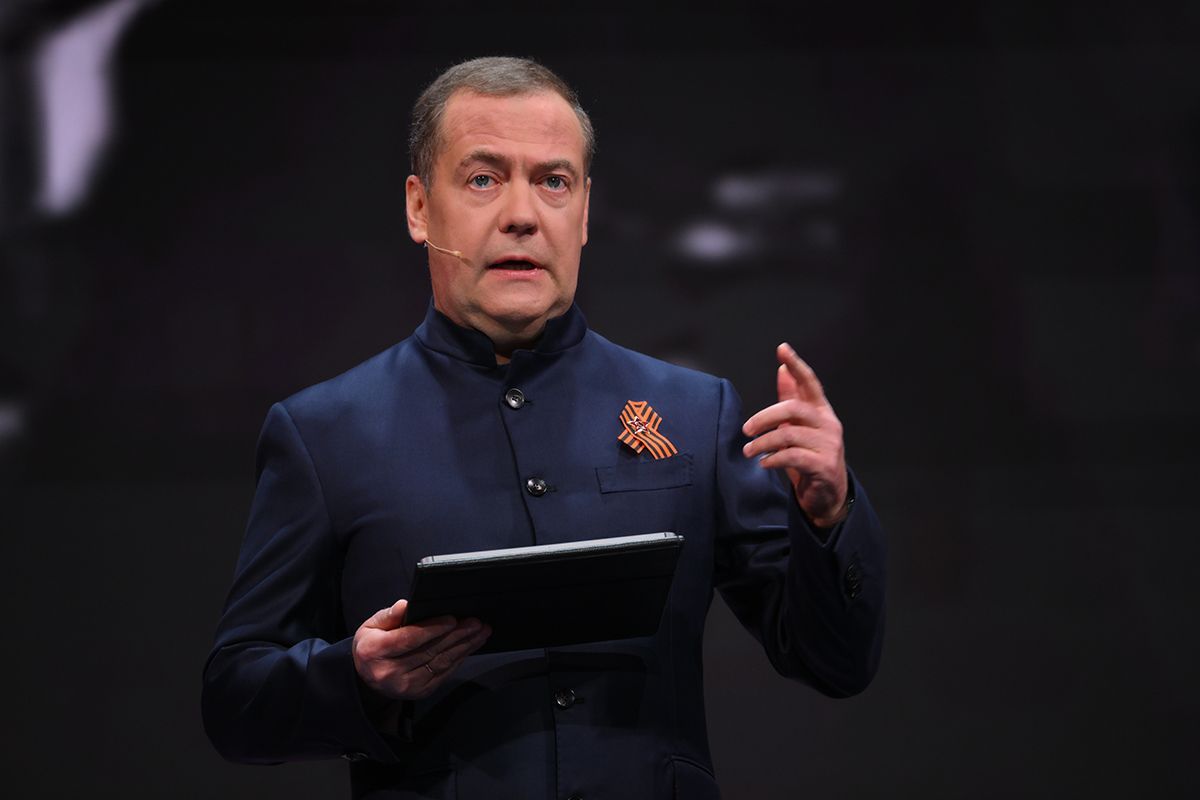
"No matter how Russophobic the Polish elites may be, one cannot but admit that on the issue of the disgusting Kyiv Banderism, they have taken the correct and honest position," Dmytro Medvedev, June 30, 2026
- Could this rise in anti-Ukrainian sentiment in Polish politics affect Rzeszow-Jasionka Airport and other hubs of Ukrainian logistics in Poland?
- This will not happen quickly, because Poland is interested in common security and in supporting Ukraine, at least the current Polish government is. As we remember, the previous Polish government was also interested in this.
Their elections will be held in a year. Despite all the rhetoric, no one will do this, although I do not rule out Russian provocations, various blockades, shutdowns, and other filth. But I think the current government will cope with this, and military cooperation will continue. Even if it did not continue, an alternative can always be found. But the fewer alternatives there are, the worse it is.
In this context, we place a great deal of hope in Romania, but let us not forget that a far-right president and his party, and a far-right party, nearly won there. Elections even had to be canceled once. So the more democratic systems and democratic governments remain in Europe, the better it is for us and for Europe.
That is why we must support the current ruling coalition in every possible way and support those healthy forces in the opposition that understand the full scale of the threat coming from Russia.
- And how can our government and sensible politicians keep the situation under control in alliance with their sensible politicians and their government? What could this be — joint roundtables, conferences, state projects, art festivals, co-produced films?
- Everything you have named is undoubtedly important, and it needs to be done. In addition, we need to listen to the message of the cardinals of the Greek Catholic Church, the Roman Catholic Church, and His Beatitude Sviatoslav, who called for the so-called disarmament of language.
And most importantly, history must be left to historians. Let them study it, while politicians should think about the shared present, the shared future, and mutual benefits. About an agreement so that there is no conflict when we enter the European Union. A series of intensive bilateral negotiations is needed on the participation of the Polish side in Ukraine’s reconstruction, on support for us in the European Union. We need to talk about joint defense projects, about an agreement in the agricultural sector (because some Poles believe we compete there), and about joint economic development.
- And what proposals can we use to interest Poland’s right-wing political spectrum and push the current negative historical discourse to the margins of mutual relations?
- Look, when the PiS party was in power, and its protégé President Duda was president, we had excellent cooperation after the start of the full-scale invasion. So, did we interest them in something? In joint resistance to Russia. In joint economic projects. In the same things that interest representatives of the left-wing spectrum. There is no great difference between them here.

We need to talk and work with both. Another matter is that we obviously cannot interest anti-Ukrainian, pro-Russian, and antisemitic forces in anything, because they are interested only in Russian money. The main thing is that centrist parties should not orient themselves too much toward them.
- Speaking of centrists. Mr. Tusk’s latest statements that Ukraine should no longer count on this unilateral friendly attitude from Poland and must take certain steps — is this a forced move by Tusk because he somehow needs not to lose the electorate that is moving toward Nawrocki? Or are there other grounds for such statements?
- Tusk is not competing directly with Nawrocki. The presidential election was held recently. It is simply that Tusk’s party, which has the highest rating, still needs to have coalition partners. It may happen that after the election there will be none. Then the right and far right, if they unite, will have a majority. And it is obvious that Tusk is appealing to voters in his own country. He is speaking to voters in his own country.
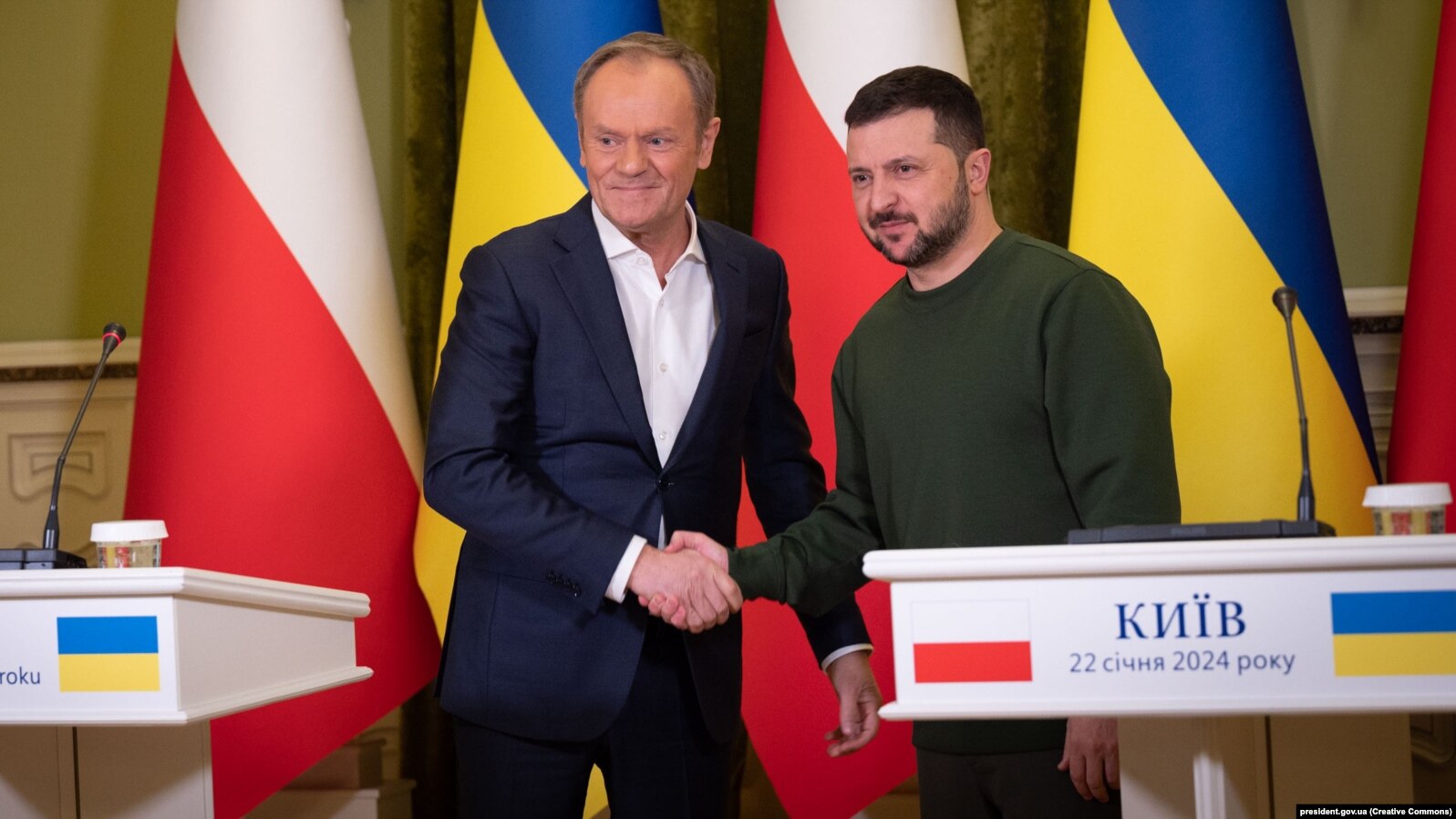
Zelenskyy and Tusk. In January 2024, Ukrainian-Polish relations were not cloudless, but they were still far from this year’s parade of demarches
This is not news. Such leaders often say such things. If you look at President Zelenskyy’s statements, at how often he behaves quite condescendingly and decisively toward those he speaks with in other countries, including to maintain popularity in his own country, then you will understand Tusk. All politicians, one way or another, say something that is meant to appeal not only to part of society, but to significant segments of it. And every politician wants to appear as a brave defender of the interests of his people. While diplomacy requires an entirely different conversation. Military cooperation requires an entirely different conversation. All of this is continuing, so I see no problems here.
- Polish and British media reported repeated warnings to Poland from the United States. Russia is allegedly planning an armed provocation on Polish territory to test NATO’s resolve, and the aim of the provocation would be to escalate tensions. Will this force the Polish authorities and Polish politicians to set aside elements of anti-Ukrainian hysteria at least for a while?
- I think the opposite may be true. Anti-Ukrainian Polish politicians will take advantage of this. This is precisely a signal of support for Russia from these anti-Ukrainian politicians. Because hybrid warfare consists precisely of a combination of so-called kinetic and cognitive methods. That is, methods of action and methods of information warfare. And a Russian attack on some small Polish targets using drones will provide leverage to demand that no weapons be supplied to Ukraine. The argument being that they need them themselves. With demands not to support Ukraine, because this is supposedly happening because Ukraine is using Poland as a transit hub and an ally. And with many other demands. That is precisely why I think the Russians might do this ahead of the elections to support these far-right parties. And, of course, to sow doubt in the societies of all other NATO member states.
Because the aim of these steps in Ukraine is not to seize these countries, but to reduce their societies’ support for Ukraine. That is what this is being done for. Therefore, I consider these scenarios quite likely. And we must do everything to prevent them from being implemented.
- So far, we have been talking about the actions of Polish politicians. But do you notice how a discourse is growing in Ukraine that says, in effect, that we will not be admitted to the EU anytime soon anyway? So if Poles are setting conditions that we renounce our heroes in exchange for accession, then it is better for us to be without the EU, but with our heroes...
- Look, Russia has always supported various right-wing ideas, far-right ideas, and far-right movements not only in Poland, but in many European countries and in Ukraine as well. The European Union is of interest to us primarily because Europe is the only source of financial support for our struggle. The European Union is also of interest to us because it has now begun to form a common defense policy and has the greatest voice in NATO. Our interest in the European Union today is primarily defensive. But it is also economic, because our ability to fight depends on the state of our economy. Everyone who opposes this, whatever they may hide behind, is obviously acting against Ukraine and against what those whom they call their heroes fought for.
At the same time, it is obvious that membership in the European Union is a matter of negotiations. Not only with Poland, because Poland alone cannot block our integration into the European Union on a contrived pretext. We need to talk with other countries about many things — including history and the economy. This is precisely a matter of diplomacy.
When we talk, for example, about the Volyn tragedy, no one claims that it did not happen. It obviously did happen. And it is obvious that Ukrainians have no right to support such actions by Ukrainian armed units that committed these atrocities against Poles.
Just as Ukrainians must remember the victims of Polish atrocities against them during that period. That is why Saint John Paul II said, repeating the formula of German-French reconciliation: "We forgive and ask for forgiveness." This is the only way, and these words are the same for all Europeans.
POLISH-UKRAINIAN RELATIONS NEED THERAPISTS, NOT BONE-SETTERS
In principle, Kniazhytskyi quite accurately formulated the essence of what is now happening between our countries: in Poland, "far-right parties raise the Ukrainian issue in order to find an image of the enemy and unite the electorate around themselves. Ordinary right-wing parties, in their struggle for the electorate, begin to play along with them. Centrists, afraid of losing this electorate, also begin to recall, albeit with less intensity, the same issues that we have not fully worked through between ourselves. In Ukraine, this provokes completely unfounded anti-Polish sentiment."
The MP also explained why it is unfounded. Kniazhytskyi loves Poland and Poles — and it is clear that what is happening pains him. But many Ukrainians will object to the MP: how is it unfounded? Just read what they are saying about us and our heroes. And we deserve to have our own memory; we have earned this right through centuries of difficult history and the enormous sacrifices of this war. Yes, some of our heroes were not angels; they had to make extremely difficult decisions under extraordinary circumstances. And we will not tolerate condescending attempts to instruct us as to which of these heroes are respectable and which are not.
In principle, this is what Kyrylo Budanov spoke about in a recent interview — the man who, according to Censor sources, became key to the practical implementation of an idea dreamed of by many generations: the creation of the Ukrainian National Pantheon. But, while remaining a HUR man even in his new position, the head of the President’s Office added that he knows the Polish side is planning actions for the next anniversary of the Volyn tragedy on July 11 that could lead to another escalation. But "Ukraine holds an unwavering position regarding any external pressure."
It is a pity, but we are being steadily — and, from the cynical point of view of implementing the plan, quite effectively — driven along the route of further confrontation. It is not difficult to foresee some of the future accusations and specific actions; they have already been voiced publicly. First, the historical track: every ideological decision by the Ukrainian authorities will be watched by the Polish side (by the way, Putin’s favorite cold term) with a magnifying glass and, accordingly, any plans by Kyiv will be interpreted grotesquely. A typical example is the story of the vote on the same law "On the Ukrainian National Pantheon," which does not contain a single surname of any future figures in this project — but about which Polish politicians and top officials have confidently piled up a mountain of quite specific conspiracy claims.
Second, judging by everything, we are facing serious turbulence in matters of military logistics and supplies of those types of weapons to which Warsaw has a direct connection. Kniazhytskyi is right — the story of the MiG-29s may not belong to the chronology of the worsening of relations. But the explanations given the other day by the Polish defense minister certainly do. And the public disputes that arose between the government and the president over the transfer of Patriot missiles to Ukraine, first, point to the general trend; and second, greatly please the Kremlin. One can only hope that the position of the European Union on this matter will restrain our Polish neighbors from taking rash steps that would be painful for us.
We are almost certainly also facing a large-scale new round of agricultural confrontation. Last month, Mr. Nawrocki practically announced a new season of this rather unpleasant trade-and-customs saga for Ukrainian agribusiness and Ukrainian carriers in general. Quote: "I also recognize that Ukraine’s accession to the European Union poses a threat to Polish agriculture. I am the president of Poland and, while understanding Ukraine’s aspirations, I will always support good treatment of Polish farmers and Polish agricultural products."
One would like to believe that Ukraine will not face problems with Polish transit — both military and civilian. We remember how hospitable Poles were to Ukrainian refugees in the first years of the war; and even now, a significant share of them do not allow their politicians to stir up revanchist sentiment within them (remember the 60% who said their "attitude toward Ukrainians has not changed" in the media poll?). Respect to these people: maintaining sobriety amid a powerful information hysteria is worth a lot.
Nevertheless, the whipping up of mutual grievances and aversion is in full swing. The media and social networks play a key role in this. You open an interview in Rzeczpospolita with tendentious statements about a dramatic rise in anti-Polish sentiment in Ukraine — and immediately read the comments, 4,500 of which have accumulated. There are Poles with their accusations of Ukrainians’ "Banderite obscurantism" and black ingratitude; and Ukrainians with their "there is no anti-Polish sentiment here," "so this is what you are like, Poles," and "just leave us alone already!" And individual foreigners with their naive, sometimes clumsy assessments. And bots from Russian bot farms — where would we be without them?
So what should be done with all of this? To my mind, the answer is obvious: sensible people must counter a carefully designed campaign of hysteria with personal communication and joint projects at all possible levels and in all possible areas. The same applies to politicians and officials. The best way to obstruct manipulation is to jointly agree to oppose it.
True, it is much easier to talk about this than to do it. There are not many people who know how to unite others around something positive, and this has always been the case. It was not for nothing that the classics of Soviet science fiction, non-Soviet in their worldview, wrote about a society torn apart by strife and in need of consolidation: "They are all surgeons or bone-setters. There is not a single therapist among them..."
Ukrainian-Polish relations need skilled therapists. Otherwise, Putin will keep applauding.
Yevhen Kuzmenko, "Censor.NET"


